
You want more than a generic house—you want a home whose bones tell a story. Timber framing answers that wish; Massachusetts’ Fairbanks House, erected in 1641, still stands as proof. So how do you turn a Pinterest dream into a build-ready plan? The seven steps below show how we align lifestyle, site, and budget to create a frame built for generations.
Step 1: Define how you live today and how it can evolve
Begin with a snapshot of the next 20 years under your roof. The average U.S. homeowner stays put about 11.8 years, so the faces at your dinner table will likely change long before you hand over the keys to the next generation.
Ask three questions while you sketch the plan:
- Who’s here, and who might join? Multigenerational households now make up 18 percent of Americans—roughly 60 million people—after quadrupling since 1971. If aging parents or adult children will rotate in, set aside a suite or flexible wing.
- Where does daily life happen? Track your hours. Do mornings orbit the kitchen island? Does remote work demand a quiet office? Timber framing’s wide spans let you cluster busy zones without load-bearing walls.
- How do you gather? A vaulted great room welcomes holiday crowds, while a pocket door cocoons movie night. Let your entertaining style set the scale, lively in public areas and restful where you recharge.
Answering these prompts now gives your designer clear targets for room count, traffic flow, and the cozy-versus-dramatic volumes the frame will create later. Hamill Creek Timber Homes starts every project with a detailed design questionnaire. That document launches the seven-step roadmap they use for custom timber frame homes, guiding clients from first sketches straight through on-site frame raising. The answers cover the purpose and location of your future building as well as your preferences for finishes and décor, then feed directly into preliminary floor plans and a 3D model you can revise with a designer in real time. Borrowing that approach with your own team, even if you never use their exact form, helps you capture your answers in writing and test-drive early layouts so you can catch missing storage, future bedroom needs, or awkward circulation while revisions are still inexpensive.
Step 2: Match the structure to the setting
Timber frames shine when the house feels stitched to its land. Walk the site at sunrise and again at dusk. South-facing glass set within thirty degrees of true south still captures about ninety percent of potential passive-solar heat, so a small rotation of the plan can trim future heating costs without sacrificing the view.
Think through three lenses:
- Arrival and first sight. A covered entry on the leeward side shields the doorway from prevailing winds, while exposed beams greet guests the moment they step out of the car.
- Light and shade. Window awnings can cut summer heat gain by up to sixty-five percent on south windows and seventy-seven percent on west windows, letting you lean into large panes without overheating the great room.
- Ground plane. Posts need solid bearing. On a slope, a walk-out basement or stepped foundation keeps timber lengths efficient and limits expensive retaining walls.
Because the frame can span twenty feet or more without interior load-bearing walls, you can center living spaces on long vistas and turn bedrooms toward quieter corners. The structure follows the land, not the other way around.
Step 3: Choose your “big moves”
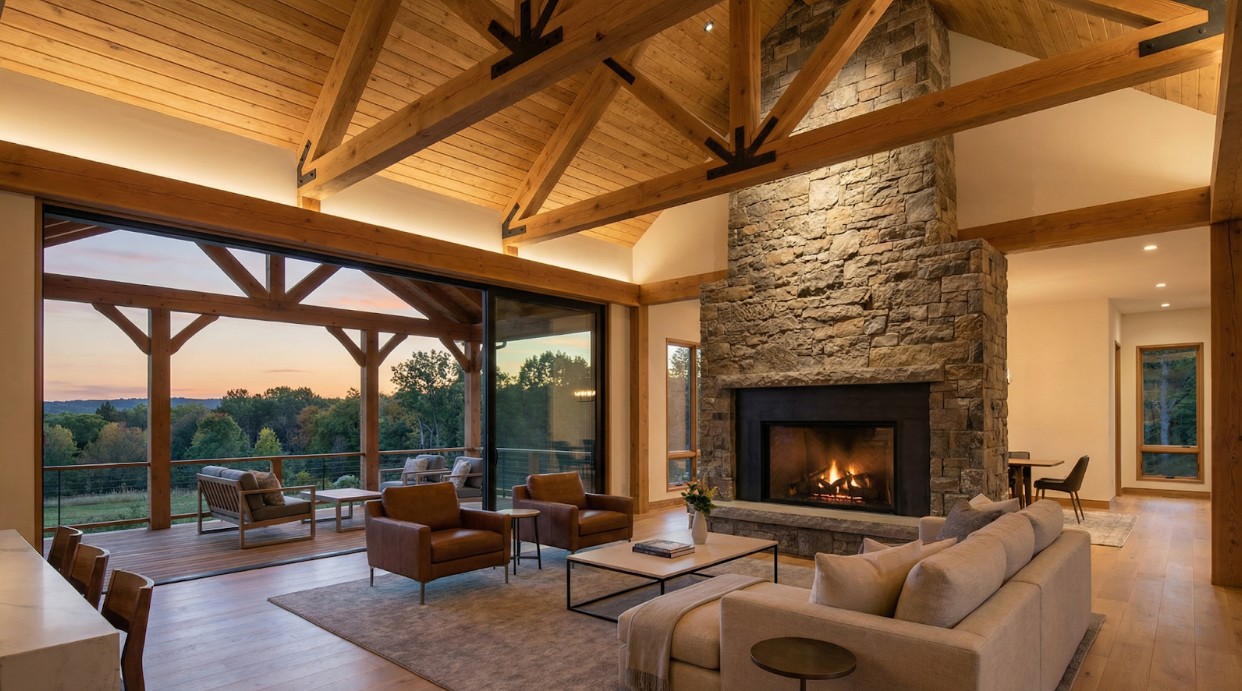
Most timber frames excel on just two or three signature gestures, the architectural equivalent of a strong hook in a song. Focus on moves you will appreciate every day, not just in a listing photo.
Buyers continue to favor connected, social spaces. Open great rooms are rising again: forty-three percent of recent kitchen remodels removed walls to adjoining rooms, up from thirty-eight percent in 2021. In contrast, two-story foyers are losing appeal; only thirteen percent of buyers consider them essential, while thirty-two percent would reject a home that includes one.
Choose with intent:
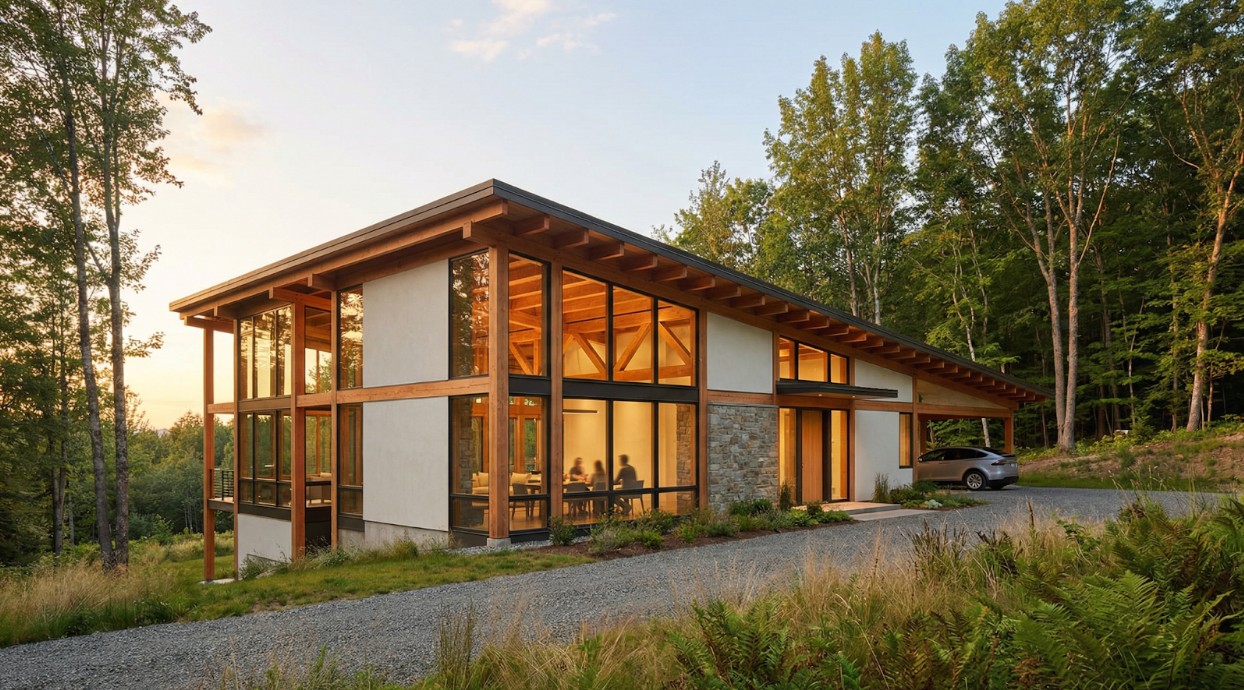
- One volume that steals the show. A vaulted great room can highlight hand-pegged trusses and draw daylight deep into the plan.
- One anchor that grounds the house. A masonry hearth or soapstone fireplace gathers dining and lounging zones.
- One threshold that frames the outdoors. A covered timber porch or pergola extends living space; thirty-three percent of 2024 homeowners upgraded outdoor areas mainly to add year-round living space.
Select the two or three moves that match how you cook, gather, and relax, then let every other choice—roof pitch, window rhythm, finish palette—support those headline moments.
Step 4: Balance the buzz of big rooms with places to exhale
Timber frames make soaring ceilings easy, yet constant openness can feel exhausting. A 2022 survey of ninety-thousand occupants in nine hundred buildings found that fifty-four percent were unhappy with sound privacy, the top complaint in the study. At the same time, wall-free living remains popular: forty-three percent of 2024 kitchen remodels removed barriers to adjoining rooms, up from thirty-eight percent in 2021.
Aim for the middle ground. Let public zones such as the kitchen, dining, and great room share one uninterrupted volume so conversations flow. Then lower the ceiling a few feet in bedrooms or a tucked-away library; research shows reduced heights encourage calm, focus, and a sense of safety. Interior windows or half walls keep sight lines intact while softening noise and containing heat.
Ask your designer to choreograph timber sizes, beam drops, and acoustic finishes so each space signals its purpose the moment you step inside: lively in gathering areas, hushed in retreat zones.
Step 5: Plan ahead for the stuff you can’t Instagram
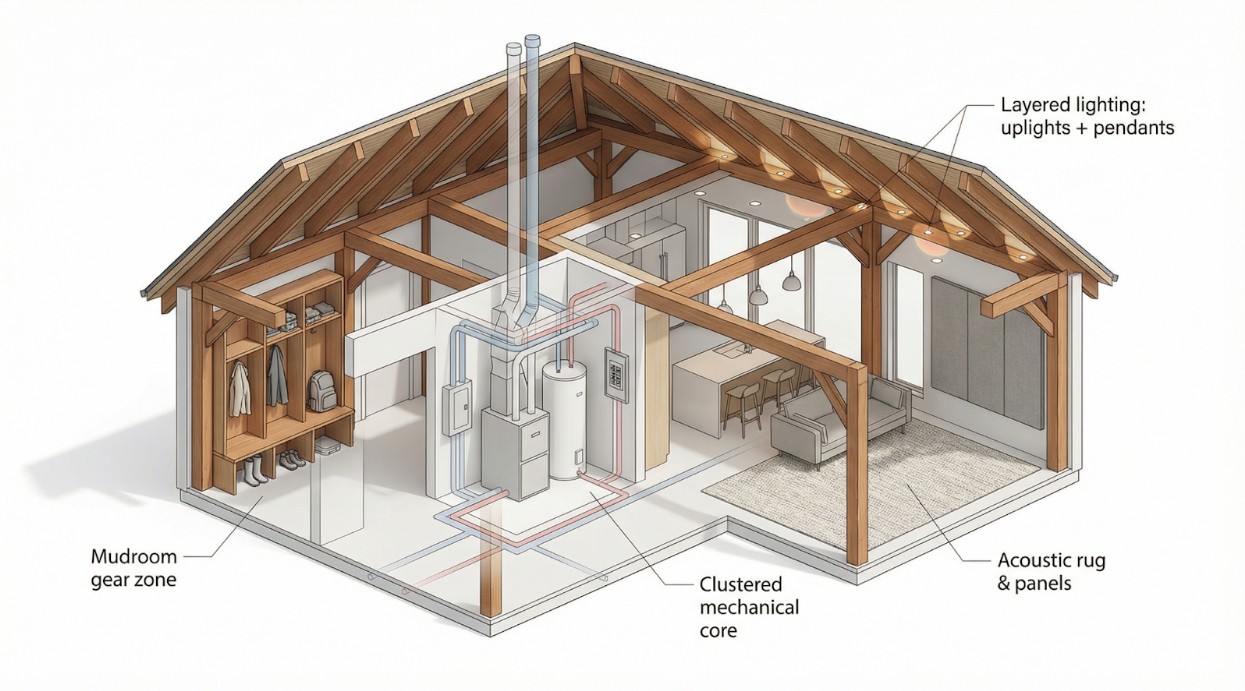
Timber trusses earn the glamour shots, yet the unglamorous guts of a house—mechanicals, storage, lighting, acoustics—shape comfort every day. In the 2022 NAHB Cost of Construction Survey, major-system rough-ins (HVAC, plumbing, electrical) consumed 17.9 percent of total construction costs. Stashing them in a cramped crawlspace is false economy.
Storage matters just as much. Sixty-five percent of 2024 buyers said “ample storage” was very or extremely important, outranking smart-home tech and even an en-suite bath.
Turn those numbers into layout moves:
- Cluster the machinery. A central utility core shortens ducts and pipes, lowers energy use, and simplifies future service.
- Dedicate a gear zone. A mudroom with full-height cubbies keeps backpacks, skis, and boots out of the great room.
- Light for texture and tasks. Pair uplights that graze rafters with island pendants. Dimmable LEDs cost slightly more up front but cut energy bills for decades.
- Tame the echo. Hard surfaces amplify sound; integrate acoustic panels or wool rugs early instead of fixing reverberation later.
Invest design hours here and you will save maintenance hours for as long as you hold the keys.
Step 6: Match your wish list to real numbers
Great architecture negotiates between imagination and math, so start with the math. NAHB’s 2025 data place the median cost of a custom single-family home at 166 dollars per square foot, up two percent from 2024 and nine percent above pre-pandemic norms. Within that figure, framing—timber, trusses, sheathing—consumes 20.5 percent of construction costs, which means every extra roof valley or dormer shows up twice, first in labor hours and again in board-foot totals.
Keep ambition and budget aligned:
- Establish the ceiling. Add land, site work, and a ten percent contingency to your all-in number before you draw the first line.
- Interrogate every square foot. Reducing a plan by two hundred square feet at 166 dollars per square foot frees about thirty-three-thousand dollars for upgraded windows or superior insulation.
- Simplify geometry. A single-plane roof costs less to frame and flash than intersecting gables yet still looks striking under exposed timbers.
- Prioritize tactile moments. Spend where your eyes linger, such as the truss layout overhead, and scale back on seldom-seen soffit details.
A design team fluent in spreadsheets and joinery will flag the swaps that deliver the highest dollar-to-delight ratio.
Step 7: Iterate, then commit
Design advances in loops, not straight lines. Architects move through three core phases: schematic design (about fifteen percent of their effort), design development (twenty percent), and construction documents (fifty-five percent). Each loop sharpens different edges:
- Schematic design may produce half a dozen floor-plan sketches before one nails the traffic flow.
- Design development resizes windows, adjusts truss spacing, and aligns structure with HVAC paths.
- Construction documents convert that frozen concept into a legal, buildable set.
On a typical custom home, expect the first two phases to cycle for eight to twelve weeks; record drawings can require another six to ten weeks, depending on complexity. When the numbers, square footage, and elevations finally align, you will sign off on the construction documents and pass them to engineers and fabricators. From that point, your role shifts to making finish selections and staying engaged on site, while the layout and structure are officially locked.
Moving from dream to reality
Timber-frame clients often spend more time planning than building. Houzz’s 2023 U.S. Renovation Survey shows that while seventy-six percent of homeowners set a budget, nearly two in five exceeded it, most often because of late design changes or product upgrades. The cure is a thorough, front-loaded process.
When you invest that time upfront, you gain more than beautiful beams:
- Rooms sized for the life you live today and the one you will grow into tomorrow
- A structure measured in generations; the Fairbanks House, built in 1641, still stands as proof
- A daily reminder that your home, land, and family stories work together
If that promise resonates, treat patience and planning as your first two building materials. Everything else will follow.
Do you know someone who might enjoy this article or would find it useful? Share it!