
When I walk a backyard with a homeowner, the first thing I study is the back of the house. The catalog comes later. The stamped concrete patterns that still look right years later are chosen from the house outward: a pattern family that echoes the architecture and the materials already on the walls, a scale that fits the space, color built in layers, and borders and joints that give the slab structure. Pick the stamp first and you spend the rest of the project trying to make the house agree with it.
Most of the homes I work around in Plainfield came out of one building wave. The village’s median home was built in 2003, and CMAP (using 2020 to 2024 American Community Survey data) puts 71.0 percent of its housing units in the 1990 to 2009 window. Single-family permits peaked at 1,449 in 2003 and 1,407 in 2005, then fell to 66 in 2009. So the typical backyard here belongs to a boom-era house, often with a brick front and vinyl siding. That pairing shapes most of my decisions, but the reasoning works on any house.
Which Stamped Concrete Patterns Suit Which Houses?
Concrete Network notes that cobblestone and ashlar slate are among the most popular patterns, and that each contractor’s stamp lineup reflects what’s popular locally. The better question is which family the house already speaks.
- Brick patterns (running bond, herringbone, basketweave) belong near brick. Concrete Network points out that traditional homes are known for brick and stone, and stamped concrete can coordinate with those materials, for example brick running bond or English Yorkstone. On a brick-front house, a running bond walk carries that language around to the back.
- Ashlar slate stamped concrete replicates hand-chiseled stone: rectangles and squares of various sizes laid in a pattern that appears random. Landscaping Network calls it popular for patios and pool decks. Its straight lines sit easily beside horizontal siding courses.
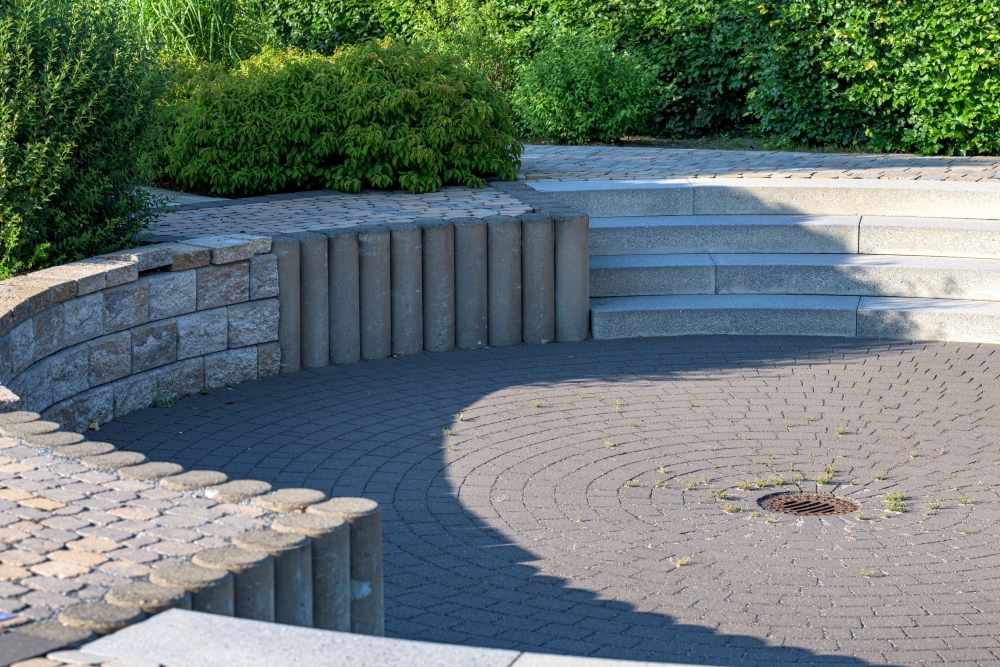
- Cobblestone and European fan patterns carry heavier texture. Fans have fractured, split-edge joints, and cobble ranges from lightly textured traditional to heavier old-world looks. They want a house with some weight, or they read as costume.
- Flagstone, random stone and bluestone feel looser and suit curving beds and planting.
- Wood plank stamped concrete imitates exposed grain; one manufacturer’s classic pattern uses six-inch-wide planks. I like it where a patio meets a deck or porch.
- Seamless texture skins imprint stone texture without grout lines, so the slab reads like giant slabs of stone. Landscaping Network notes that saw cuts in a large diamond pattern are often added for large-scale pattern. On a cleaner, more modern facade, that restraint is usually the most architectural choice.
How Big Should the Pattern Be?
Scale is where I see the most stamped concrete designs go wrong. My own judgment after years of patios: on a small patio, smaller patterns like herringbone brick or cobblestone add character without overwhelming, while oversized stone feels cramped, as if the slab ran out before the pattern could finish. On a large surface the reverse holds. A small module turns into visual static, and bigger stones let the space breathe.
Among stamped concrete walkway ideas, my favorite is the simplest: a field whose units are clearly smaller than the walk’s width, framed by a border on both edges.
Building Stamped Concrete Colors in Layers
Stone and old brick never wear one flat color, so good stamped concrete colors are built in layers. According to stampedconcrete.org, the base color comes first, from integral color or a dry-shake color hardener. Antiquing comes next from pigmented powder or liquid release agents, sometimes supplemented by stains or tints.
The two base methods behave differently:
- Integral color runs through the whole slab, so a chip or scratch still shows color. Its tones are typically subtler and less vibrant.
- Color hardener colors only the top 1/8 to 3/16 inch, so gray can show if damage goes deeper. It suits a precise hue, stronger saturation or multiple colors, and adds abrasion resistance.
The release agent keeps the stamp mats from sticking and adds the antiquing that makes color look natural.
I coordinate rather than match. Concrete Network suggests tying the color to the siding or natural stone veneer, often with a contrasting border. On a boom-era house I might pull the base from a lighter brick tone and let the release echo the darker brick or the roof. An exact match tends to look like a painted copy of the wall. And since fresh concrete lightens as it cures, when in doubt I go slightly darker. For readers nearby, local photos of stamped concrete in Plainfield show how common patterns and palettes sit against the area’s brick-front homes.

Borders, Bands and Where the Joints Go
A border does for a patio what trim does for a window. Concrete Network suggests borders and bands in contrasting colors and patterns, including stamped borders around fields of broom-finished or exposed aggregate concrete, which looks good and costs less because there’s less stamping labor and material. One stamp tool manufacturer’s border stamps run from under 8 inches to a bit over 12 inches wide, so the frame can be sized to the slab.
Joints belong in the drawing too. Concrete Network says to space control joints (in feet) no more than 2 to 3 times the slab thickness in inches, so a 4-inch slab gets joints 8 to 12 feet apart. With stamped work, ask how the joints will stay out of the pattern. I plan them into grout lines or border lines, and I use them to divide big areas into modules that align with doors and house corners.
Freeze-Thaw Detailing Is Part of the Design
Chicago O’Hare’s normal snowfall is 38.4 inches a year (1991 to 2020), and the daytime high stays below freezing on about 39 days a year on average. Will County’s main soils, per NRCS, are silty clay loam glacial till that drains moderately slowly or slowly, so drainage and base preparation come first.
NRMCA’s guidance on preventing surface scaling calls for air-entrained exterior concrete, about 6 percent total air with 3/4 inch or 1 inch aggregate, exterior slabs ordered at 4,000 psi, and no deicers the first winter. Use sand for traction that season. The Michigan Concrete Association and others say never to use deicers containing ammonium sulfate or ammonium nitrate, and the Minnesota Pollution Control Agency found magnesium chloride causes the greatest degradation among chloride deicers. Resealing every two to three years, ideally in fall before snow, is typical in the Upper Midwest.
FAQ
Stamped concrete vs pavers: how do they compare?
Angi’s 2026 national figures put stamped concrete at roughly $9 to $22 per square foot, with an average project of $5,319; brick patterns run about $9, slate about $11, cobblestone about $14 and wood plank about $16. Angi notes stamped concrete offers more pattern customization and prevents weeds, while pavers hold color better and allow single-piece replacement but are prone to weeds and settling. Stamped concrete is one slab, so it can crack, needs resealing every 2 to 3 years, and repairs are hard to match exactly.
Will a stamped concrete pool deck be slippery?
Concrete Decor magazine notes that slickness usually comes from the topical sealer. Ground polymer grit can be added to the sealer (no more than 3 ounces per gallon), or a penetrating sealer can replace acrylic.
How many stamped concrete patterns and colors can one patio carry?
The strongest stamped concrete patio ideas I’ve built use one field pattern, one border and a restrained palette. Every added pattern should mark a real change in use or direction.
Do you know someone who might enjoy this article or would find it useful? Share it!